The Carter G. Phillips / Sidley Austin LLP Supreme Court Clinic
A two-decade partnership between Northwestern Pritzker School of Law and Sidley Austin LLP, the Supreme Court Clinic provides elite pro bono representation while giving law students a chance to do hands-on work at every stage of Supreme Court litigation. It is one of the nation’s longest-running clinical programs focused exclusively on the Supreme Court. In 2024, the Clinic—and the Appellate Advocacy Center of which it is a part—were renamed in honor of law school alumnus Carter Phillips, a founder and longtime co-director of the Clinic.
The Clinic's current faculty are Professor Danielle Hamilton; Sidley partners Carter Phillips and Tobias Loss-Eaton; Jeffrey Green of Green Lauerman Chartered PLLC; and Sarah Schrup of Appellate Advisory LLC.
We welcome inquiries from lawyers and parties looking for help in seeking Supreme Court review or litigating at the Court. Because we have limited resources, we accept only cases that are plausible candidates for Supreme Court review.
What We Do
The Clinic represents parties in every aspect of Supreme Court litigation: Filing or opposing petitions for writs of certiorari; filing amicus briefs at the certiorari or merits stages; and litigating merits cases. We handle cases in all different subject areas, with particular experience representing criminal defendants, immigration petitioners, and civil-rights plaintiffs. We never insist that a Clinic lawyer handle the oral argument before the Court, but the Clinic's lawyers have extensive oral argument experience and are sometimes asked by clients or co-counsel to argue a case.
We also provide moot courts for advocates preparing for oral argument, with panels of Northwestern faculty and experienced appellate practitioners serving as the justices. Our moots offer counsel appearing before the Supreme Court an opportunity to hone and refine their strategies in advance of argument. Our moots can be conducted on a virtual or in-person basis, with no cost to advocates. Our moots also are unique in that one of the students in the Clinic (coached by Clinic Co-Directors) takes on the role of opposing counsel during the moot. This permits a more realistic assessment of how the overall questioning about the case likely will play out before the Court in the real oral argument.
Because we litigate only in the Supreme Court, we commonly work in partnership with the lawyers who already represented our clients in the lower courts. The Clinic has a long track record of working collaboratively with public defenders, defense attorneys, civil-rights lawyers, and litigants of all kinds. We contribute Supreme Court expertise and credibility, elite advocacy, and the resources of a longstanding big-firm appellate practice. All the Clinic’s work is pro bono, with no charge to clients.
Our recent cases include:
- Successfully petitioning for certiorari and then securing a unanimous merits victory in Abouammo v. United States, No. 25-5146, concerning venue for criminal prosecutions.
- Securing a grant, vacatur, and remand in Busby v. Mississippi, No. 25-6885, addressing the Confrontation Clause’s application to forensic "technical reviewer" testimony.
- Filing cert- and merits-stage amicus briefs on behalf of the Human Rights Defense Center and the American Association for Justice in Olivier v. City of Brandon, No. 24-993, which ended in a win for the civil-rights plaintiff.
- Securing a grant, vacatur, and remand in Zielinski v. United States, No. 25-5067, addressing affirmative defenses for parents who violate custody arrangements because they fear abuse.
- Providing briefing and oral-argument support in Rivers v. Guerrero, No. 23-1345, and Soto v. United States, No. 24-320, both argued by Sidley lawyers in spring 2025.
- Successfully securing a grant, vacatur, and remand over the State of Colorado’s objection in Fields v. Colorado, No. 24-5460, addressing how the Sixth Amendment applies to state habitual-offender regimes.
- Successfully sought certiorari in Fischer v. United States, No. 23-5572, presented oral argument, and procured a 6-3 victory rejecting the government’s position that the Sarbanes-Oxley obstruction of justice provision cannot be applied outside the context of official and corporate records.
- Representing the petitioner at the merits stage in Brown v. United States, 22-6389, concerning the meaning of "serious drug offense" in the Armed Career Criminal Act.
- Successfully petitioning for certiorari and representing the petitioner at the merits stage in Kahler v. Kansas, No. 18-6135, addressing whether the Constitution requires an insanity defense.
- Representing the respondents at the merits stage in United States v. Davis, No. 18-431, a successful due process challenge to a federal gun-possession statute.
The Student Experience
Through the year-long Clinic program, third-year law students gain unparalleled experience and insight into Supreme Court practice. The Clinic has four main components:
Classroom Instruction
The Clinic's weekly classroom sessions feature in-depth instruction on every aspect of Supreme Court practice from the Clinic’s co-directors. We cover the mechanics of seeking Supreme Court review, appellate strategy and advocacy, amicus briefs, oral argument, and black-letter doctrine. We also feature guest speakers from the Court, the Solicitor General’s Office, and the Court’s press corps.
Case Work and Circuit Monitoring
Clinic students, working together with Sidley lawyers, research and draft briefs in real Supreme Court cases. The students also monitor lower court decisions to identify promising cases to take to the Court. In recent years, our students' monitoring work has led directly to wins for clients at the Court.
Moot Courts
Students attend or participate in every Clinic moot court, serving as moot panelists or opposing advocates. Indeed, our moots are unique in that we always have a student act as the mooting lawyer's opponent, which provides additional insight that can inform the lawyer’s preparation.
Visiting the Court
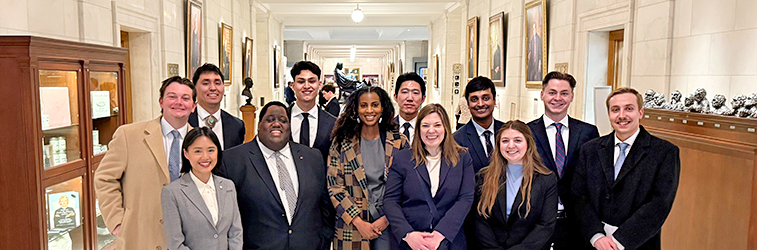
Whenever possible, the Clinic makes a yearly in-person visit to the Court. The trip typically features attendance at oral argument, a behind-the-scenes tour of the Court, and a celebratory dinner with Sidley lawyers who worked on Clinic cases that year.
Hear more from clinic students about their Supreme Court Clinic experience: