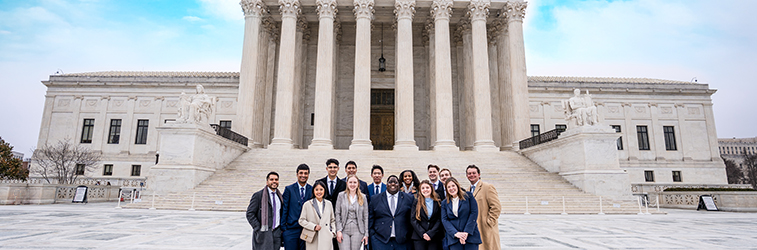
Carter G. Phillips Center for Supreme Court and Appellate Advocacy
The Carter G. Phillips Center for Supreme Court and Appellate Advocacy has been a core part of the Northwestern Pritzker School of Law's Bluhm Legal Clinic for nearly twenty years. The Center is directed by Professor Danielle Hamilton, and operated in partnership with attorneys from Sidley Austin LLP. The Center serves the Northwestern Pritzker Law community and the general public through three primary avenues.
First, the Center offers two year-long Clinical courses, the Federal Appellate Litigation Clinic and the Carter G. Phillips/Sidley Austin LLP Supreme Court Clinic. These clinics are available to third-year law students at Northwestern. Our goals are to provide unparalleled service to our clients, while concurrently giving students an intensive, hands-on experience to practice appellate law.
Second, the Center operates a moot program, which offers counsel appearing before the Supreme Court an opportunity to hone and refine their strategies in advance of argument. Our moots can be conducted on a virtual or in-person basis, involve the participation of Northwestern faculty and leading practitioners in the Chicagoland area, and are offered free of charge to advocates.
Third, the Center organizes a variety of research, policy, and other events for the Northwestern Pritzker Law community. This includes supervising students seeking to pursue an Appellate Concentration; inviting guest speakers to Chicago, including Justices of the Supreme Court; and publishing relevant scholarship in law reviews.