Children and Family
Justice Center
Northwestern Pritzker
School of Law
375 East Chicago Avenue
Chicago, IL 60611-3069
312.503.8576 phone
312.503.8977 fax
cfjc@law.northwestern.edu


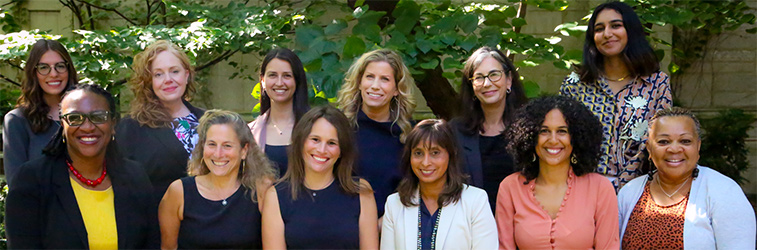
Children and Family Justice Center
Welcome to the Children and Family Justice Center
Providing access to justice for youth is a core mission of the Children and Family Justice Center (CFJC). Each year, CFJC faculty, staff and students represent young people on a wide range of matters including delinquency, criminal court, immigration and asylum, resentencing, clemency, and reducing the collateral consequences youth face after coming into contact with the law. Oftentimes, the CFJC gives its young clients access to a lawyer when they otherwise would not have one.
The CFJC also actively collaborates, both locally and nationally, on key policy and law reform initiatives affecting youth and young adults. CFJC attorneys forge deep connections—from the grassroots level all the way up to government agency leadership—to develop fair, effective, and lasting strategies for systems reform.
As a teaching institution, the CFJC trains law students in critical lawyering skills such as interviewing, counseling, investigation, legal writing, negotiation, and oral advocacy. CFJC professors encourage students to step into the role of lawyer and take ownership over their cases and projects, while providing intensive supervision and regular feedback. In the process, students have the unique opportunity to develop both the skills and the confidence they need to become effective lawyers.
As a holistic children’s law center, the CFJC has long provided social work support as an integral part of its legal advocacy. Originally incubated at CFJC, the Bluhm Legal Clinic’s new Social Work Advocacy Program (SWAP) not only provides exceptional service to our clients but serves as a field placement for training masters-level social work students.
Whether advocating in front of judges and policymakers or strategizing in the classroom, the CFJC strives to promote racial equity and reduce incarceration and other harmful approaches to young people.
About the Children and Family Justice Center
Founded in 1992, the Children and Family Justice Center (CFJC) is a comprehensive children's law office and part of the Bluhm Legal Clinic at Northwestern Pritzker School of Law. At the CFJC, attorneys and law students work together to promote justice for children, adolescents, and their families through direct legal representation, policy advocacy and law reform. More...
Support Us
Find out why your donation matters and the difference you can help us make.

The need for a statewide public defender system
In a Chicago Tribune commentary “Illinois legislators should create a statewide system for public defense”, CFJC’s Policy Director Stephanie Kollmann explains why defendants in Illinois often are denied their constitutional right to a strong defense.
“A 2021 report on Illinois public defense funded by the U.S. Department of Justice and commissioned by the Illinois Supreme Court is clear: Current conditions have resulted in people being denied their rights,” according to Kollmann, who cited multiple studies — including a multiyear, interdisciplinary assessment of public defense budgets and projected staffing levels in each of Illinois’ 102 counties led by CFJC’s Director (at that time) Julie Biehl.
“The good news is that there is a solution,” Kollmann wrote. “And there is support in Springfield to make it happen. Under the leadership of Senate President Don Harmon and the Illinois Supreme Court, the Illinois General Assembly put this issue on the legislative agenda in April, urging consideration of a statewide office to provide public defenders with support they so badly need.”
Kollmann’s commentary calls on legislators to follow Harmon’s lead and “create a statewide public defense system that is organized around the needs of clients and responsive to the expertise of public defenders, and builds capacity for the state to meet constitutional standards.”
Email Updates - Are you on our subscriber list? Sign up below to receive our newsletters and occasional updates about our work.